Hospitality’s Future Is Not About Owning More Hotels - It’s About Managing Them Better
For decades, hospitality success was defined by one thing: ownership. More keys. More land. More buildings.
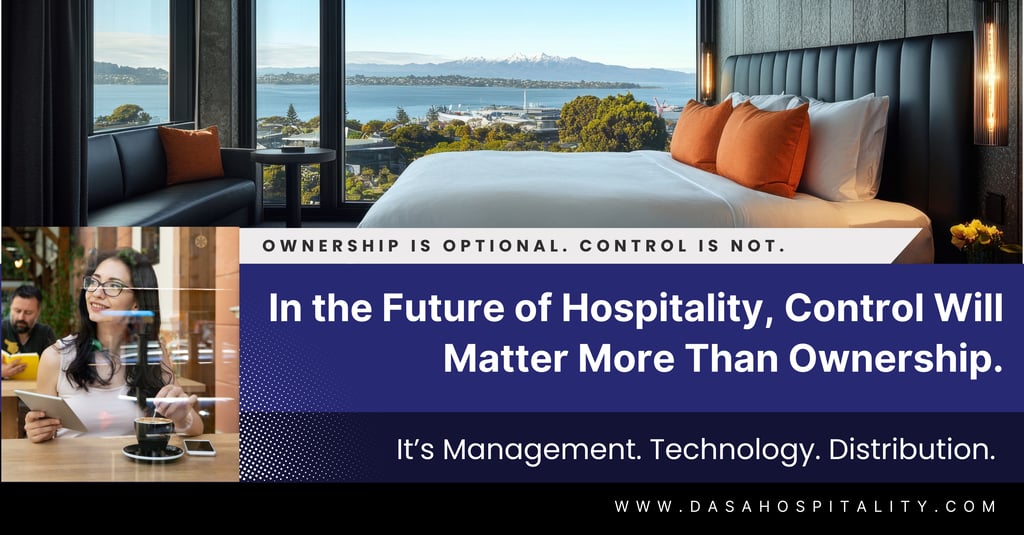
For decades, hospitality success was defined by one thing: ownership. More keys. More land. More buildings.
But quietly — and now very clearly — the industry has shifted.
👉 The future of hospitality is not ownership-heavy. It is management-led, tech-powered, and distribution-driven.
And those who understand this early will control far more rooms than they ever own.
1. Ownership Is Capital-Intensive. Management Is Intelligence-Intensive
Owning hotels ties up:
Heavy capital
Long payback cycles
High fixed costs
Market risk concentration
On the other hand, hospitality management scales through systems, not assets.
Today, one strong operator can:
Manage 5 hotels across 3 cities
Control pricing, inventory and reputation remotely
Influence revenue without owning a single room
This is why global brands, white-label operators and asset-light hospitality companies are expanding faster than traditional owners.
Control > Ownership.
2. Technology Is No Longer Support — It Is the Business
Earlier, PMS and channel managers were “tools.” Today, they are decision engines.
The modern hospitality stack decides:
What price to sell
Where to sell
When to close or open inventory
Which guest segment to prioritize
Hotels that still run on:
Manual pricing
Static rates
OTA dependence without strategy
…are not competing with hotels anymore. They’re competing with algorithms — and losing.
Tech-driven hotels don’t react to demand. They predict it.
3. Distribution Power = Revenue Power
The real battlefield is not rooms. It’s visibility.
Ask yourself:
Who controls the hotel’s OTA ranking?
Who manages rate parity?
Who decides when to push direct vs OTA?
Who optimizes sponsored listings, meta, and conversions?
In many hotels, the owner doesn’t even understand this layer.
That’s dangerous.
Because whoever controls distribution controls cash flow.
Future hospitality leaders will be:
Distribution strategists
Revenue architects
Channel negotiators
—not just property holders.
4. Management Companies Will Replace Individual Owners’ Capabilities
A strong management company today provides:
Centralized revenue management
Virtual front office & guest handling
Distribution & OTA optimization
Brand positioning & online reputation
Cost optimization & performance reporting
This turns fragmented, underperforming hotels into networked revenue assets.
Just like:
Asset management in real estate
Portfolio management in finance
Hospitality is moving the same way.
5. The New Hospitality Leader Is a Hybrid
The future hospitality professional is not:
Only a hotelier
Only a tech person
Only a marketer
They sit at the intersection of:
Operations
Technology
Revenue
Distribution
Guest psychology
This hybrid skillset will define the next decade.
Degrees won’t matter as much as:
Data interpretation
System thinking
Market sensing
Execution speed
Final Thought
Hotels will always exist. Buildings will always be built.
But value creation is shifting away from bricks — and toward brains.
Those who master:
Management over ownership
Tech over tradition
Distribution over dependency
…will shape the next era of hospitality.
The question is no longer: “How many hotels do you own?”
The real question is: “How many hotels do you control?”
Quick Links
Get in touch for hospitality growth solutions.
Follow
Subscribe
connect@dasahospitality.com
+91 8010321245
© 2026 DASA HOSPITALITY PVT LTD All Rights Reserved | Privacy Policy | Terms & Conditions